
Signal Movement in Organizations
A structural model of detection, interpretation, authority, and decision under urgency and legitimacy pressure.
What gets noticed doesn’t always move the same way through the system.
These mechanics become more visible when effort increases, decision timelines extend, and responsibility does not fully resolve within structure.
How Signals Move Through Organizations Under Urgency and Legitimacy Pressure
Organizations constantly receive signals.
A signal may appear as:
-
an unexpected outcome
-
a system irregularity
-
a customer complaint
-
an operational anomaly
-
a concern raised by someone close to the work
Most signals are first detected by people closest to execution. Frontline operators, analysts, and operational staff often notice subtle changes before those signals reach formal reporting channels.
Detection is therefore rarely centralized. It occurs throughout the organization.
Once detected, signals must move through a process of interpretation and coordination before action can occur.
Environmental Pressure and Decision Closure
Organizations rarely interpret signals in neutral conditions.
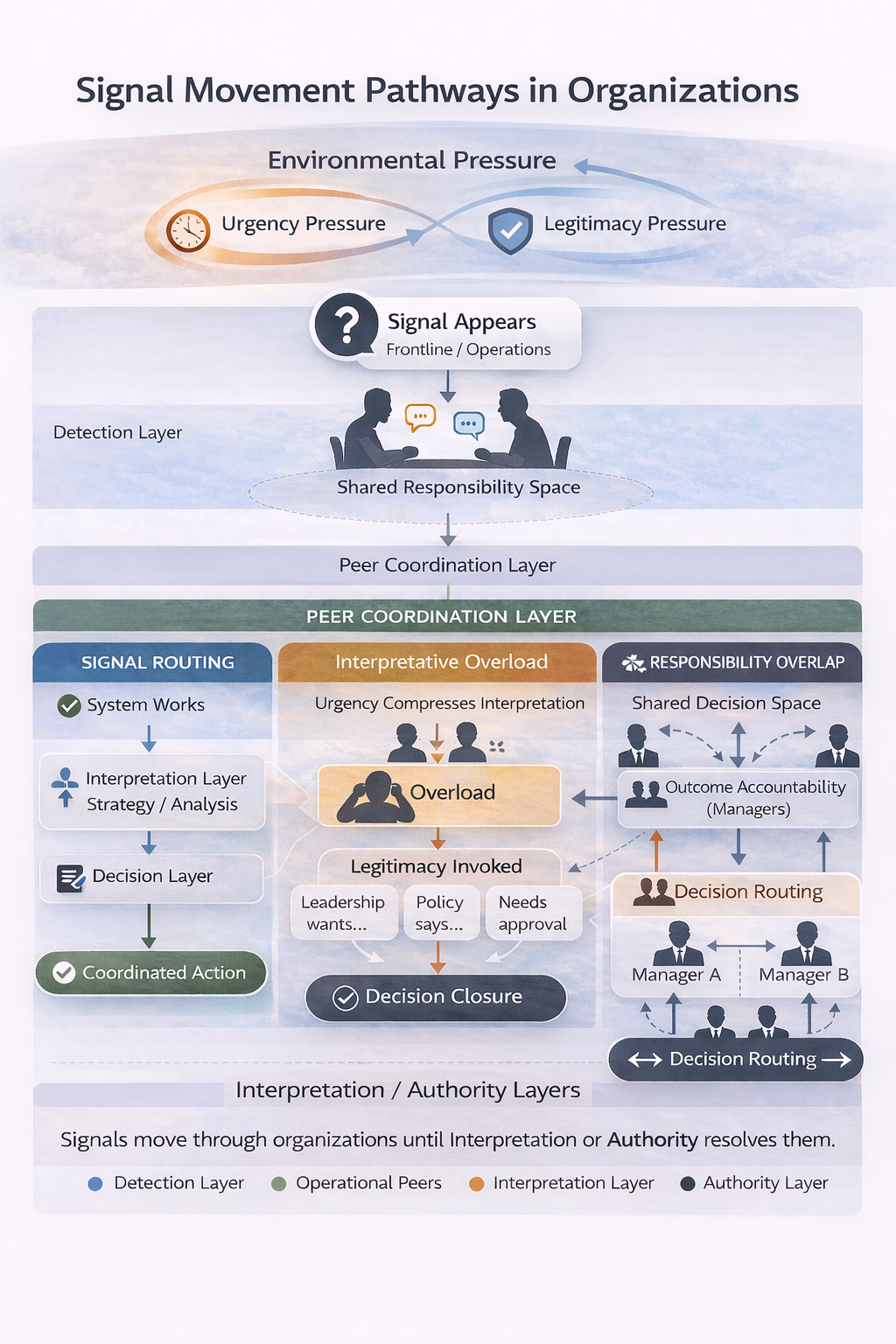
Two environmental pressures frequently shape how signals move through a system: urgency pressure and legitimacy pressure.
Urgency compresses the time available for interpretation. As deadlines approach or operational pressure rises, organizations tend to move more quickly toward decision closure.
Legitimacy provides a mechanism for closing decisions when interpretation cannot continue. Authority
signals such as policy, leadership direction, or formal approval allow coordination to proceed even when interpretation remains incomplete.
These pressures often reinforce one another. As urgency rises, organizations rely more heavily on legitimacy to resolve decisions. Once legitimacy is invoked, interpretation tends to shorten further, accelerating decision closure.
Detection and Peer Coordination
Signals typically appear first within operational environments. Someone notices something unusual:
-
a pattern that doesn’t match expectations
-
a result that feels inconsistent
-
a small anomaly in an otherwise normal process
This detection usually occurs within peer coordination spaces where operational staff compare interpretations and share observations before escalation occurs.
Signal Routing
In well-structured systems, signals are routed to the appropriate interpretation layer. Specialists or designated teams evaluate the situation through analysis before decisions are made.
Signal detected → interpretation routed → analysis occurs → decision authority acts → coordinated action follows.
Interpretative Overload
Interpretive overload occurs when signals remain within the peer coordination layer and interpretation cannot move upward.
Operational teams attempt to interpret the signal locally while urgency compresses the time available for escalation or deeper analysis. As this continues, it can appear as decisions taking longer to resolve, responsibility becoming less clearly defined, or the work itself requiring more effort to maintain alignment. At this point legitimacy signals often appear:
-
"Leadership wants us to proceed.”
-
“Policy says we should do it this way.”
-
“This needs approval before we continue.”
Responsibility Overlap
Responsibility overlap occurs when interpretation reveals a situation that falls between multiple authority structures. Operational peers may recognize the signal, but the key question becomes:
Which authority structure owns the decision?
Legitimacy signals emerge to resolve this ambiguity until a responsible authority determines the outcome.
Interpretation and Authority
Signals move through organizations until one of two mechanisms resolves them: interpretation or authority.
Interpretation resolves signals through analysis, explanation, and pattern recognition. Authority resolves signals through legitimacy, decision rights, and accountability structures.
Environmental pressure determines how long interpretation can continue before authority closes the decision.
These models describe structural processes through which signals move before patterns become visible.
These processes are part of how workplace cognition forms, shaping how signals are interpreted, decisions are made, and responsibility is carried within work environments.