
Visibility Treated as Direction
Measurement guides orientation.
In some work environments, what is visible begins to shape what is followed.
What gets measured starts to guide what gets done.
Measurement systems expand while strategic clarity remains fluid.
Dashboards update consistently.
Performance becomes legible.
Observation intensifies.
This can extend decision timelines as visibility signals are interpreted as direction without clear structural alignment.
Tracked metrics begin shaping attention.
Trend replaces purpose in conversation.
Display compresses explanation.
Visibility becomes the organizing variable.
Signal Grid
The pattern can also be observed across phases:
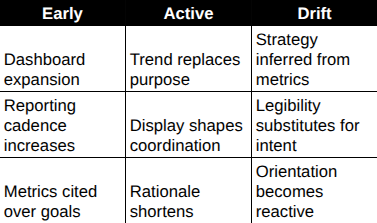
Measurement does not replace direction.
It can displace it.
Coordination organizes around what is seen rather than what is intended.
In practice, this can appear as decisions taking longer to resolve, responsibility becoming less clearly defined around direction, or work requiring more effort to interpret what should guide action.
This pattern reflects how pressure and visibility shape coordination within workplace cognition under sustained conditions.
In lower-signal environments, similar patterns may appear through diffusion rather than compression, with attention dispersing rather than narrowing.
This note describes structural conditions. It does not assess individuals or organizations.